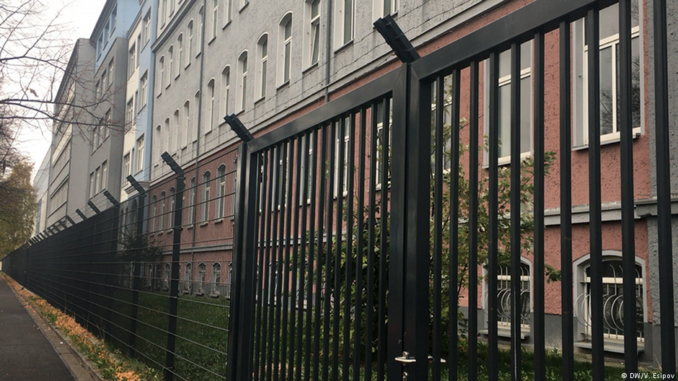
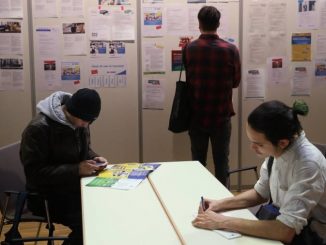
About 500 people live in the initial reception facility in the Dresden district of Friedrichstadt. Here, they wait behind barbed wire for authorities to decide on their asylum applications. Most applicants come from Syria, Iraq, Afghanistan and, strangely enough, from the democratic nation of Georgia, which is seeking EU and NATO membership. One-fifth of the facility’s inhabitants are Georgian.
In 2017, after Germany ruled that Georgian citizens no longer needed visas, the number of asylum seekers coming to Germany from Georgia tripled. In 2018, 2976 applications were registered. Most of them, according to the Georgian embassy, are in the German states of Saxony in the east and North Rhine-Westphalia in the west.
Read more: Frankfurt Book Fair: Spotlight on Georgia, a country of contrasts
Economic problems in Georgia
Eter Hachmann also comes from Georgia. She grew up in the capital, Tbilisi, moved (legally) to Germany eight years ago, studied law and joined Germany’s Social Democratic Party (SPD). Today, she is deputy chair of the Dresden branch of the SPD. She is doing her doctorate and working for the Ausländerrat Dresden e.V., a non-profit organization that gives support to migrants.

Hachmann: Georgia still has social problems
She believes that Germany is attractive for Georgians because of the higher wages and the much better standard of living. “A lot has changed in Georgia, but social problems remain,” says Hachmann, and cites a simple example: An asylum seeker is provided with accommodation by the German state, along with €400 ($455) per month, while a couple could get 800 euros. Although this is modest by German standards, it is much more than an average salary in Georgia, she says.
But German authorities remain tough. Poverty does not give grounds to apply for asylum in Germany. Not even 1 percent of Georgian asylum seekers are classed as legitimate refugees. In order to speed up the processing of asylum applications made by Georgian citizens, the federal government wants to classify Georgia as a safe country of origin.
In September and October, two charter planes with about 100 Georgian citizens flew from Leipzig to Tbilisi. But deporting migrants on charter flights is not a cheap undertaking. According to the Saxon Refugee Council, the costs for such a charter flight could amount to €95,000 ($108,000). According to the Saxon Ministry of the Interior, there are currently 511 Georgian citizens in the state whose asylum applications have been rejected. This means they have to leave Germany.
Read more: My Europe: Georgia fights over its future
Asylum applications and deportations
The Saxon Refugee Council is critical of refugees being deported to Georgia. Press spokesman Mark Gärtner describes the authorities’ actions as “ruthless.” He says families are being torn apart and that children with disabilities are being returned to Georgia who cannot receive qualified medical care there. Gärtner does not regard the Georgian refugees as “economic migrants.” He says that the lack of qualified medical services in Georgia could pose a threat to life and therefore be regarded as a legitimate motive for fleeing the country.

Gärtner: The authorities are ‘ruthless’
The Georgian ambassador to Germany, Elguja Khokrishvili, noted in a written statement to DW that the vast majority of asylum applications submitted by Georgian citizens were unfounded. He said that the Georgian government reacted immediately to the increase in the number of asylum seekers in some EU states after they abolished the visa requirement and came up with a package of legislative and practical countermeasures.
“These measures include an intensive and extensive information campaign, amendments to the law on criminal prosecution for aiding and abetting illegal migration and tighter controls on departure,” said the ambassador. The efforts had already produced positive results, he said: In some EU states, including Germany, the number of asylum applications had fallen significantly. “The figures from September, which show a 77.7 percent decrease compared to January 2018, are encouraging and give reason to hope that an improvement can be expected in the coming months,” Khokrishvili said.
Georgian translators in demand
Meanwhile, according to the Saxon Ministry of Justice, the proportion of non-German nationals in prisons is growing. Currently, almost a third of prisoners are foreigners, with Georgia ranking fourth after Poland, Tunisia and Libya. As a result, expenditure on translators has quintupled in the last three years, from €104,000 in 2015 to an estimated €534,000 in 2018. Georgian is one of the languages where there is an increasing demand for translators by the police, courts and hospitals.
Eter Hachmann also occasionally works as a Georgian translator in court. She is not allowed to talk about individual criminal cases. She merely hints that it is mostly theft that is involved. The offenders often “cooperated” with “colleagues” from Russia and Chechnya, she says.
According to Hachmann, many refugees do not want people in their home country to know what is really going on with them. They tell their relatives that they have found a job in Germany or are going to a university. Whereas, in fact, they spend their days in a refugee shelter behind barbed wire.
-
Georgia – a holiday destination between the Caucasus and the Black Sea
Georgia, melting pot of cultures
Multicultural, multi-ethnic, multi-religious: This is Georgia. The breathtakingly beautiful country between the Caucasus and the Black Sea is one of the oldest settlement areas of mankind. Today about 3.7 million people live in this small country with its magnificent nature and culture.
-
Georgia – a holiday destination between the Caucasus and the Black Sea
The capital Tiblisi
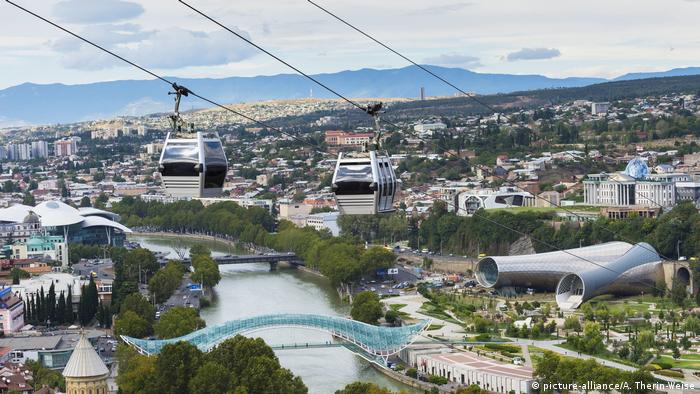
The metropolis of Tbilisi is Georgia’s cultural centre. And it has been since the 5th century. The city has known Roman, Arab, Turkish, Persian and other conquerors. Russia invaded Georgia in 1799 and remained there until the end of the Soviet era. They all left their traces. Tbilisi celebrates the present day with new constructions such as the Peace Bridge and the Concert Hall (right).
-
Georgia – a holiday destination between the Caucasus and the Black Sea
Old town and fortress
Since the 3rd century, the Narikala fortress has kept watch over the old town with the typical balconies and carvings on the houses. The panorama path up to the fortress leads through a labyrinth of alleys. The massive castle has seen conquerors come and go, was destroyed and rebuilt again and again. Only a lightning strike in the powder warehouse (1827) turned it into a ruin.
-
Georgia – a holiday destination between the Caucasus and the Black Sea
Where the royals resided
The Metekhi Virgin Mary Church can be seen on the steep bank of the Kura, which flows through Tbilisi. From the 12th century, the residence of the Georgian kings was located on this site, as is indicated by the equestrian monument next to the church. It depicts King Vakhtang Gorgasali, the founder of Tbilisi. In 1937, under Soviet rule, the residence was demolished. The church survived.
-
Georgia – a holiday destination between the Caucasus and the Black Sea
700 years of bathing culture
The Abanotubani district with its hot thermal springs is considered the oldest part of Tbilisi. The springs have been used for 700 years. The Persian-style bathhouses were built later, in the 17th century. The bathing rooms are located under the domed brick vaults. A number of them are still in use today and are a popular meeting place to bathe and chat.
-
Georgia – a holiday destination between the Caucasus and the Black Sea
7,000 years of wine cultivation
They are called Chinuri, Chichwi or Orbeluri. Grape varieties from Georgia enjoy an excellent reputation. The largest wine-growing areas are in the east of the country, in Kakheti. Archaeological finds prove that wine was cultivated in Georgia over 7,000 years ago. And even this very day wine is cultivated in amphorae. UNESCO declared this method an intangible cultural heritage.
-
Georgia – a holiday destination between the Caucasus and the Black Sea
70 years of Soviet rule
When you travel through the country, you will encounter relics from Soviet era: Houses, factories, monuments or, as here, this viewing platform on a former military road near Kazbegi mountain. All of them stone testimonies. Georgia was part of the Soviet Union for 70 years – until 9 April 1991, when the people voted for independence in a referendum.
-
Georgia – a holiday destination between the Caucasus and the Black Sea
Hiking in the Caucasus
The most diverse landscapes and climate zones are concentrated in the most compact area; from the mountain villages of the Caucasus to the beaches of the Black Sea. Almost half of Georgia is covered with forest. Two thirds of the country is mountainous, with several 5,000 meter (16,404 ft) peaks. Numerous nature reserves and national parks make Georgia a worthwhile destination for hikers.
-
Georgia – a holiday destination between the Caucasus and the Black Sea
A remote UNESCO World Heritage Site
2,200 meters above sea level, in the Great Caucasus, lies Ushguli – “Courageous Heart”; a community of four villages with roots dating back to the 16th century BC. Ushguli is considered to be the highest situated permanently inhabited place in Europe. Since 1996, the villages with their characteristic fortified towers have been UNESCO World Heritage Sites.
-
Georgia – a holiday destination between the Caucasus and the Black Sea
Vardzia – city in the rock
Up to 50,000 people lived in the cave town of Vardzia. It lies in the south of Georgia. It was built in the 12th century as a fortress to defend against Turks and Persians. It was carved by hand with simple tools into a 500 meter high rock face, seven storeys above each other. There were bakeries, stables, a treasury and a church.
-
Georgia – a holiday destination between the Caucasus and the Black Sea
The old capital of Kutaisi
160 kilometers from the Black Sea coast lies the old capital of Georgia, Kutaisi. It was the residence of the Georgian kings from the 10th century until 1122. Many are buried here. Churches, monasteries, palace ruins and the well-preserved medieval townscape make this city worth a visit. Today it is the economic and cultural center of West Georgia.
-
Georgia – a holiday destination between the Caucasus and the Black Sea
Coastal town of Batumi
The Black Sea coast. The climate is mild Mediterranean. The port city of Batumi, the third largest city in Georgia, beckons you to take a stroll along the beach. The promenade is flanked by art objects. It is not the only contrast. Between the derelict residential buildings, huge malls and luxury residential buildings are being built. A well-known real estate mogul has invested here: Donald Trump.
-
Georgia – a holiday destination between the Caucasus and the Black Sea
Hospitality & traditions
More than twenty different ethnic groups live in Georgia, including Azerbaijanis, Armenians, Arameans, Jews and Greeks. They brought their traditions and customs with them. And the Georgians? They love their own traditions and do not miss a single festival to wear their traditional costumes. They celebrate passionately – with traditional music and dances. Folk festivals are always a spectacle.
Author: Anne Termèche (sbc)
Each evening at 1830 UTC, DW’s editors send out a selection of the day’s hard news and quality feature journalism. You can sign up to receive it directly here.